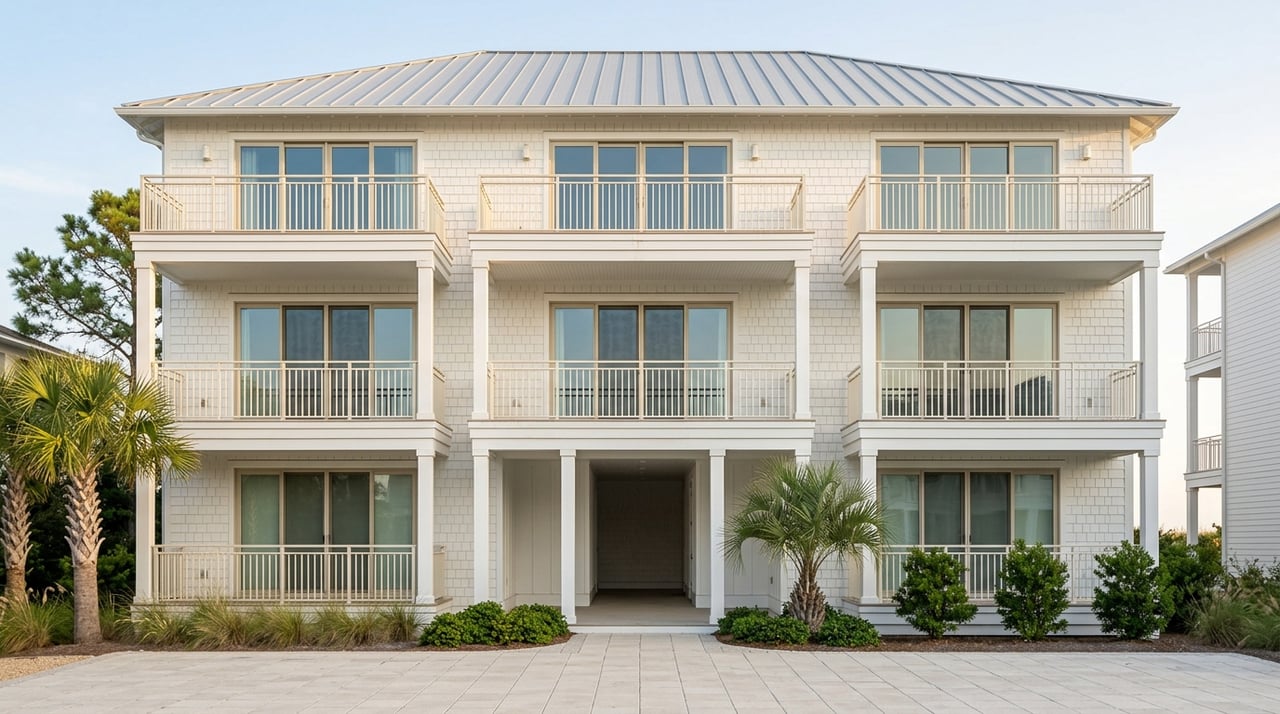
If you are eyeing Watersound for vacation-rental income, one question usually rises to the top fast: should you buy a condo or a home? The answer is not one-size-fits-all, especially in a place where property types, price points, and rental patterns vary so widely. If you want to balance lifestyle, ease of ownership, and revenue potential with more confidence, this breakdown will help you see the tradeoffs clearly. Let’s dive in.
Watersound Is Not One Market
Before you compare a condo to a home, it helps to understand that Watersound is not a single uniform market. The Watersound brand spans multiple communities and experiences across Bay and Walton counties, with options that include single-family homes, townhomes, apartments, and other residential formats.
That matters because pricing, amenities, and rental appeal can look very different depending on the specific subcommunity. Broad public market data shows that spread clearly, with one public source showing a median Watersound listing price around $725,000, while Zillow’s WaterSound Beach submarket shows an average home value near $1.92 million.
For you as a buyer, that means the condo-versus-home decision should be made at the community level, not just the brand level. A beachfront condo in WaterSound Beach and a home in Watersound Origins can serve very different goals.
Why Rental-Focused Buyers Compare Condos And Homes
Most rental-focused buyers are weighing three things at once: purchase price, operating complexity, and income potential. Watersound makes that comparison especially important because condos and homes often sit in different parts of the market.
A condo may offer a more contained ownership experience with building-side amenities and a potentially simpler launch path at the county level. A home may offer more privacy, more flexibility, and better alignment with the way the local short-term rental market is currently built.
Neither option is automatically better. The right fit depends on whether you value simplicity and low-maintenance ownership more, or whether you are trying to maximize guest capacity and rental upside.
Condo Pros For Watersound Buyers
Lighter County Compliance Path
In Walton County, most short-term vacation rentals must register annually, pay a $300 annual fee per structure, use a local responsible party, and provide required disclosures about occupancy, parking, trash, and noise. The county also requires state and local prerequisites such as Florida Department of Revenue registration, DBPR licensing, and Tourism Development Tax registration.
But there is an important distinction for condo buyers. Walton County states that condominiums are excluded from the county certification process, even though condo owners still need to complete the required state tax, licensing, and local tax registrations.
For many nonlocal buyers, that can mean fewer county-level steps compared with a single-family rental home. It does not mean automatic rental approval, but it can make the compliance path feel more streamlined.
More Turnkey Amenities
Recent WaterSound Beach condo listings show how appealing the condo format can be for second-home buyers who also want rental use. Public examples highlight features like onsite management, beach boardwalk access, pool access, garage parking, storage, EV charging, and even repeat-guest rental history.
That package can be attractive if you want a property that feels polished and guest-ready from day one. It can also appeal to buyers who prefer less exterior maintenance responsibility than they would typically have with a standalone home.
Premium Beach Access In A Smaller Footprint
Watersound condos can offer a luxury coastal experience without the footprint or upkeep of a larger house. If your priority is strong personal enjoyment, easy lock-and-leave ownership, and direct access to beach-oriented amenities, a condo may check those boxes well.
That said, condos occupy a smaller niche in the local short-term rental landscape. So while they can perform well for the right buyer and guest profile, they are not necessarily the market’s dominant rental product.
Home Pros For Watersound Buyers
Better Match For Local Rental Demand
Public short-term rental data suggests that Watersound is primarily a house-driven market. AirROI’s Watersound report says 95.2% of active short-term rental supply is made up of houses, while only 4.8% is apartment or condo inventory.
The same data shows that 53.2% of listings are 3-bedroom properties, 84.7% are 2- to 3-bedroom units, and 62.1% accommodate eight or more guests. That points to a guest base that often travels in families or larger groups, which generally favors homes over condos.
If your main objective is revenue maximization, a single-family home is often the more natural fit with local demand patterns. More bedrooms, more sleeping capacity, and more outdoor living space can widen your appeal to group travelers.
More Control Over The Asset
A home typically gives you more direct control over how the property functions. You may have more flexibility around outdoor space, storage, parking, layout, and how the property is presented to guests.
That can matter if you are thinking like an investor and want to shape the guest experience carefully. In a rental market where larger groups are common, that added control can support stronger positioning.
Wider Range Of Price Points
Homes in the broader Watersound umbrella span a much wider pricing range than many buyers expect. Public examples in Watersound Origins include homes around the high-$700,000s, around the $900,000 range, and into the $1.7 million range, while luxury home sales in WaterSound Beach and Camp Creek have reached well above $3 million and up to nearly $5 million.
That wider spread can create more choice depending on your budget and strategy. You may be able to target a neighborhood-oriented home with strong amenity access, or pursue a more luxury-oriented property if your plan centers on premium rental rates and personal use.
The Compliance Difference Matters
What Walton County Requires For Homes
If you buy a single-family attached or detached home for short-term rental use in Walton County, the county requires more visible compliance steps. Those can include exterior signage, indoor posting, occupancy limits, parking details, evacuation notices, noise and trash notices, and wildlife or turtle notices where applicable.
The county also requires a local responsible party who must be reachable 24 hours a day, 7 days a week, and able to respond within one hour. For out-of-town owners, that adds a layer of operational planning that should be built into your decision.
What Condo Buyers Should Still Check
Although condos are excluded from Walton County’s certification process, condo buyers should not assume that means fewer overall restrictions. State registrations and licensing still apply, and the property still needs to fit your intended use.
This is where careful due diligence matters. A condo may feel operationally easier at the county level, but you still want to understand the full ownership picture before you buy.
Price And Value Look Different By Property Type
A condo and a home in Watersound often deliver value in different ways. Recent public condo examples in WaterSound Beach include listings around $2.199 million, $3.145 million, and $3.329 million, with a 2-bedroom, 2-bath condo sale at $1.65 million.
Homes, by contrast, range from more moderate price points in communities like Watersound Origins to ultra-luxury beachfront and estate properties. In other words, you are not simply choosing between two property types. You are often choosing between two very different ownership experiences and investment profiles.
For some buyers, a high-end condo feels more efficient because the amenity package is built in. For others, a larger home offers more room to grow rental revenue and more control over the guest experience.
Seasonality Should Shape Your Plan
Watersound’s short-term rental market is seasonal, and that affects both condos and homes. AirROI’s 2026 report estimates average annual Airbnb revenue at $58,018, average occupancy at 38.8%, average daily rate at $524, and RevPAR at $216.
The strongest months are July, June, and March, while January, November, and December are softer. The report also estimates an average stay of about 5.1 nights, with bookings happening roughly 54 days in advance.
That seasonality means your underwriting should be conservative and realistic. Whether you buy a condo or a home, you want to look at peak-season upside alongside off-season performance and carrying costs.
When A Condo Makes More Sense
A Watersound condo may be the better fit for you if:
- You want a more lock-and-leave ownership style
- You value beach access and building-managed amenities
- You prefer a potentially lighter county-level compliance path
- You expect more personal use and selective rental use
- You are comfortable with a smaller niche in the local STR market
Condos can be especially appealing for buyers who want premium coastal living with less day-to-day property oversight. In that sense, the condo choice can be about lifestyle efficiency as much as investment logic.
When A Home Makes More Sense
A Watersound home may be the better fit for you if:
- Your top priority is rental revenue potential
- You want to serve larger family or group travel demand
- You prefer more control over the property and guest setup
- You want a broader range of home sizes and price points
- You are prepared for a more hands-on compliance and operations path
In Watersound, public rental data suggests homes are generally more aligned with how the market performs today. If your buying lens is heavily investment-driven, that is an important signal.
A Smart Way To Decide
If you are still choosing between a condo and a home, start with your actual goal, not just the property itself. Ask yourself whether you are buying primarily for personal enjoyment with rental income as a bonus, or whether you are buying to optimize revenue first.
Then compare each option through three filters:
- Demand fit: Does the property match how guests are booking in Watersound?
- Operational ease: How much compliance, coordination, and upkeep are you willing to take on?
- Financial structure: Does the price, expected income, and ownership cost profile support your plan?
That kind of side-by-side review usually brings the answer into focus quickly. In Watersound, condos often win on simplicity and turnkey appeal, while homes often win on scale and rental alignment.
If you want help comparing specific Watersound opportunities through both a lifestyle and rental lens, Katie Atwater and Mike Henderson can help you evaluate the numbers, the ownership tradeoffs, and the fit for your long-term goals.
FAQs
Do Watersound condos need Walton County vacation-rental certification?
- No. Walton County says condominiums are excluded from the county certification process, but condo owners still need applicable Florida Department of Revenue registration, DBPR licensing, and Walton County Tourism Development Tax registration.
Do Watersound homes usually have more rental upside than condos?
- Public short-term rental data suggests they often do, because the Watersound rental market is heavily house-based and geared toward 2- to 3-bedroom stays and groups of eight or more guests.
Are all Watersound properties priced similarly?
- No. Public data shows a wide range, from broader median listing prices around $725,000 to WaterSound Beach values near $1.92 million, with individual condos and luxury homes priced much higher.
What does Walton County require for Watersound rental homes?
- For single-family attached or detached short-term rentals, Walton County requires annual registration for most properties, a $300 annual fee per structure, a local responsible party, and posted rules covering items like occupancy, parking, trash, noise, and emergency notices.
Is a Watersound condo or home better for a second-home buyer?
- It depends on your priorities. A condo may suit you better if you want easier ownership and strong amenity access, while a home may suit you better if you want more space, more control, and stronger alignment with local group-rental demand.